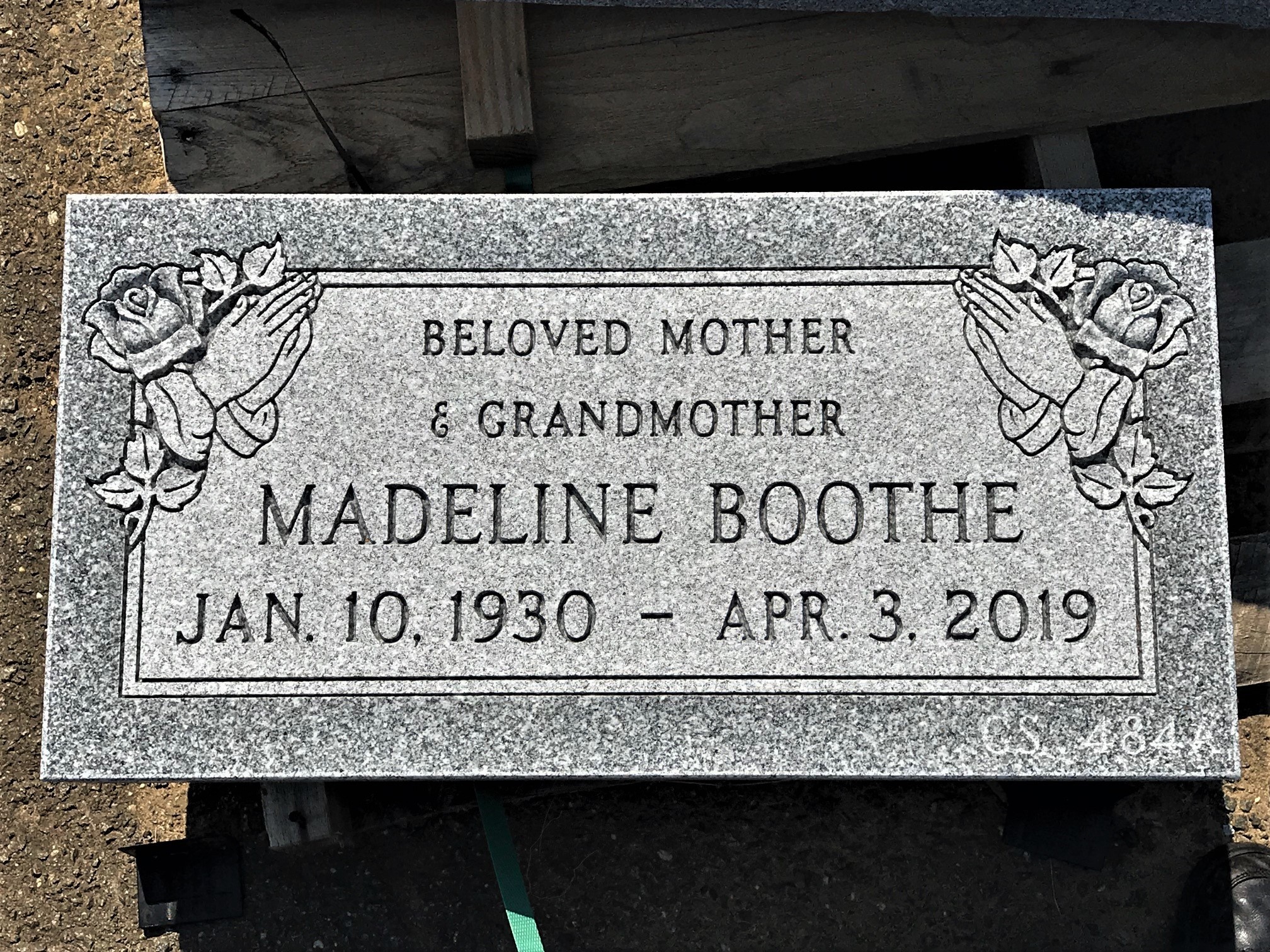
How Are Flat Grave Markers Installed? Foundations, Placement & Cemetery Rules
|
By the Abby Rose Inc. Team
Flat grave marker installation involves more than simply placing a stone over a burial site. Because these memorials are designed to sit at or near lawn level, the location, support, alignment, and cemetery specifications all need to be considered before the marker is set. Abby Rose Inc. provides custom flat grave markers for families throughout New Jersey and Pennsylvania and coordinates cemetery requirements, delivery, and professional installation as part of the memorial process.
Understanding how installation works can help families know what happens between approving a memorial design and seeing the completed marker at the cemetery.


How is a Flat Grave Marker installed?
The exact installation process varies according to the cemetery, memorial material, marker dimensions, and site conditions.
In general, the process includes:
Confirming cemetery requirements
Obtaining any necessary approvals
Confirming the exact grave location
Preparing the installation area
Creating the required support or foundation
Positioning and leveling the marker
Checking alignment and surrounding grade
Completing the installation according to cemetery standards
The objective is to create a stable, properly positioned memorial that complies with the rules of the cemetery.
Why cemetery approval comes before installation
The cemetery should be involved before the marker arrives at the burial site.
Cemeteries can establish rules covering:
Memorial type
Width and length
Thickness
Material
Granite color
Bronze markers
Foundations
Placement
Installation procedures
Some cemeteries also divide their grounds into sections with different monument regulations.
A section intended for upright monuments may have different requirements from a lawn section where only flush markers are permitted.
This is why Abby Rose Inc. verifies cemetery requirements before a memorial is produced rather than waiting until installation day to discover whether it complies.
Preparing the grave site
Once the memorial and installation requirements have been approved, the installation area needs to be prepared.
Flat markers are intended to maintain a low profile, so the surrounding grade is an important consideration.
The site must allow the marker to be positioned correctly relative to the surrounding ground while remaining stable.
The preparation required can depend on:
Soil conditions
Marker dimensions and weight
Cemetery requirements
Existing foundations
Nearby memorials
Ground conditions at the grave
Professional installation allows these factors to be assessed at the site rather than treating every grave as identical.
Do Flat Grave Markers need a foundation?
Foundation and support requirements vary by cemetery.
A stable base or other approved support may be required to help keep the marker properly positioned over time.
The cemetery may specify how the support must be constructed, its dimensions, or who is permitted to prepare it.
For this reason, families should not assume that every flat marker uses exactly the same foundation method.
The appropriate installation should follow the cemetery's specifications for that particular grave and memorial.
Why proper leveling matters
One of the defining characteristics of a flat marker is its relationship to the surrounding lawn.
Unlike an upright headstone, which rises vertically from a base, a flat marker is designed to remain low to the ground.
Careful leveling helps ensure that:
The marker sits correctly in the designated space
The inscription remains properly oriented
The memorial aligns appropriately with neighboring markers
The installation complies with cemetery requirements
The marker integrates with the surrounding grade
The final position should be checked before the installation is considered complete.
How are granite Flat Markers installed?
Granite is a popular material for cemetery memorials because of its strength, durability, and ability to hold detailed inscriptions and designs.
A granite flat marker is a solid stone memorial, so its weight and dimensions need to be considered during handling and installation.
The prepared site must provide the appropriate support, and the marker needs to be positioned according to the cemetery's approved orientation and placement.
Granite markers can be personalized with names, dates, epitaphs, emblems, and engraved imagery before they are delivered for installation.
Families can explore available granite colors and materials before the memorial design is finalized.
Is installing a bronze grave marker different?
Bronze flat markers have a different construction from solid granite markers.
A bronze memorial is commonly produced as a plaque and may be mounted on a granite base. The complete memorial is then installed according to the cemetery's specifications.
The dimensions of both the bronze plaque and its supporting base need to be considered during approval.
Some cemeteries or cemetery sections may specifically require bronze markers, while others permit granite or a selection of approved materials.
Checking these requirements early prevents a family from selecting a memorial that cannot be installed in the intended section.
Who determines where the marker is placed?
The exact location of a memorial is not chosen arbitrarily.
The cemetery identifies the grave space and establishes where the marker is permitted to be positioned in relation to the burial plot and surrounding memorials.
Placement requirements help maintain consistent spacing and ensure that markers remain within the correct grave boundaries.
For companion plots or adjacent family graves, the approved placement may also affect whether a larger shared marker can be used.
Who can install a flat grave marker?
This depends on the cemetery.
Some cemeteries handle certain installation work themselves, while others permit approved monument companies or installers to perform the work according to cemetery specifications.
Families should check the cemetery's policies rather than assuming they can install a marker independently.
Professional coordination is especially valuable because the installer needs to know the approved location, marker specifications, and any foundation requirements before work begins.
How long after burial can a Flat Marker be installed?
There is no universal waiting period that applies to every cemetery.
Installation timing can depend on cemetery policy, ground conditions, burial procedures, monument approval, production time, and other practical factors.
Some families begin the design process soon after burial even when the marker itself cannot yet be installed.
Starting the design and cemetery approval process earlier can help ensure that the memorial is ready when installation is permitted.
For more information about timing, read our guide to when a headstone can be placed after burial.
Does marker size affect installation?
Yes.
The dimensions and weight of the memorial affect handling, site preparation, support requirements, and cemetery approval.
Single and companion markers can have different specifications, and cemeteries may establish maximum or required dimensions for each.
If you're still determining which dimensions are appropriate, our guide to flat grave marker sizes explains common sizes and the cemetery requirements that influence them.
What happens after a Flat Marker is installed?
Once the memorial has been positioned, the installation should be checked for alignment, stability, orientation, and compliance with the approved placement.
The surrounding area may also need to be finished so the marker integrates properly with the cemetery lawn.
Over time, normal ground and environmental conditions can affect cemetery memorials. If a marker appears to shift significantly or requires attention later, families should contact the cemetery or an experienced memorial professional rather than attempting to reposition a heavy stone themselves.
Flat marker installation vs. Upright monument installation
Flat and upright memorials have different installation requirements.
An upright monument typically consists of a vertical stone mounted on a base and requires an installation designed to support the above-ground structure.
A flat marker remains at or near lawn level and has a much lower profile.
The difference affects not only appearance but also site preparation, foundations, handling, and cemetery requirements.
Families deciding between these memorial styles can read our comparison of flat markers vs. upright headstones.
From design to final installation
Installation is the final stage of a process that begins long before the memorial reaches the cemetery.
The marker first needs to be designed around the family's preferences and the cemetery's requirements. Dimensions, material, inscriptions, artwork, and placement all need to work together.
Once those details are approved, the memorial can be produced and the installation coordinated.
Abby Rose Inc. works with families throughout New Jersey and Pennsylvania to design, coordinate, and professionally install flat grave markers, helping ensure the memorial meets cemetery requirements from the initial design through final placement.
Frequently asked questions about flat grave marker installation
How are flat grave markers installed?
The site is prepared according to cemetery requirements, the appropriate support or foundation is established, and the marker is carefully positioned and leveled in its approved location. Exact procedures vary by cemetery and memorial type.
Do flat grave markers need a concrete foundation?
Foundation requirements vary by cemetery. Some may specify a particular support or foundation system, so the requirements for the specific grave should be confirmed before installation.
Are flat grave markers completely flush with the ground?
Flat markers are designed to maintain a low, lawn-level profile, but the exact positioning depends on the marker design and cemetery specifications.
Can I install a grave marker myself?
Not necessarily. Cemeteries may restrict who is permitted to install memorials or require installation to follow specific procedures. Always check the cemetery's policies before arranging installation.
How long does it take to install a flat grave marker?
The physical installation is only one part of the process. Overall timing can depend on cemetery approval, memorial production, site readiness, scheduling, and cemetery requirements.
Does the cemetery decide where a flat marker goes?
Yes. The cemetery identifies the burial space and establishes the permitted placement of the memorial within the grave or plot.
Similar Blogs
More Helpful Guides & Articles
Discover more articles about cemetery rules, bronze memorials, and headstone design to support your decision-making process.


