Ledger stones in NJ: full-cover grave slabs, design, pricing and cemetery rules
|
By the Abby Rose Inc. Team
Families considering a ledger stone for an NJ cemetery are usually looking for something more substantial than a traditional headstone or flat marker. A ledger stone, sometimes called a grave ledger or full grave slab, extends horizontally across most or all of the burial space, creating a distinctive memorial with significantly more room for inscriptions, religious imagery, portraits and custom artwork. In New Jersey, however, these memorials require careful planning because not every cemetery—or even every section within the same cemetery—allows full grave covers. Before choosing the granite or beginning the design, the first step should always be confirming exactly what the cemetery permits.
Abby Rose Inc. has spent more than 25 years designing, engraving and installing custom memorials for families throughout New Jersey and Pennsylvania. With ledger stones in particular, our process starts with the cemetery and gravesite so the final memorial is designed around the actual size, foundation and installation requirements that apply to the plot.


What is a ledger stone?
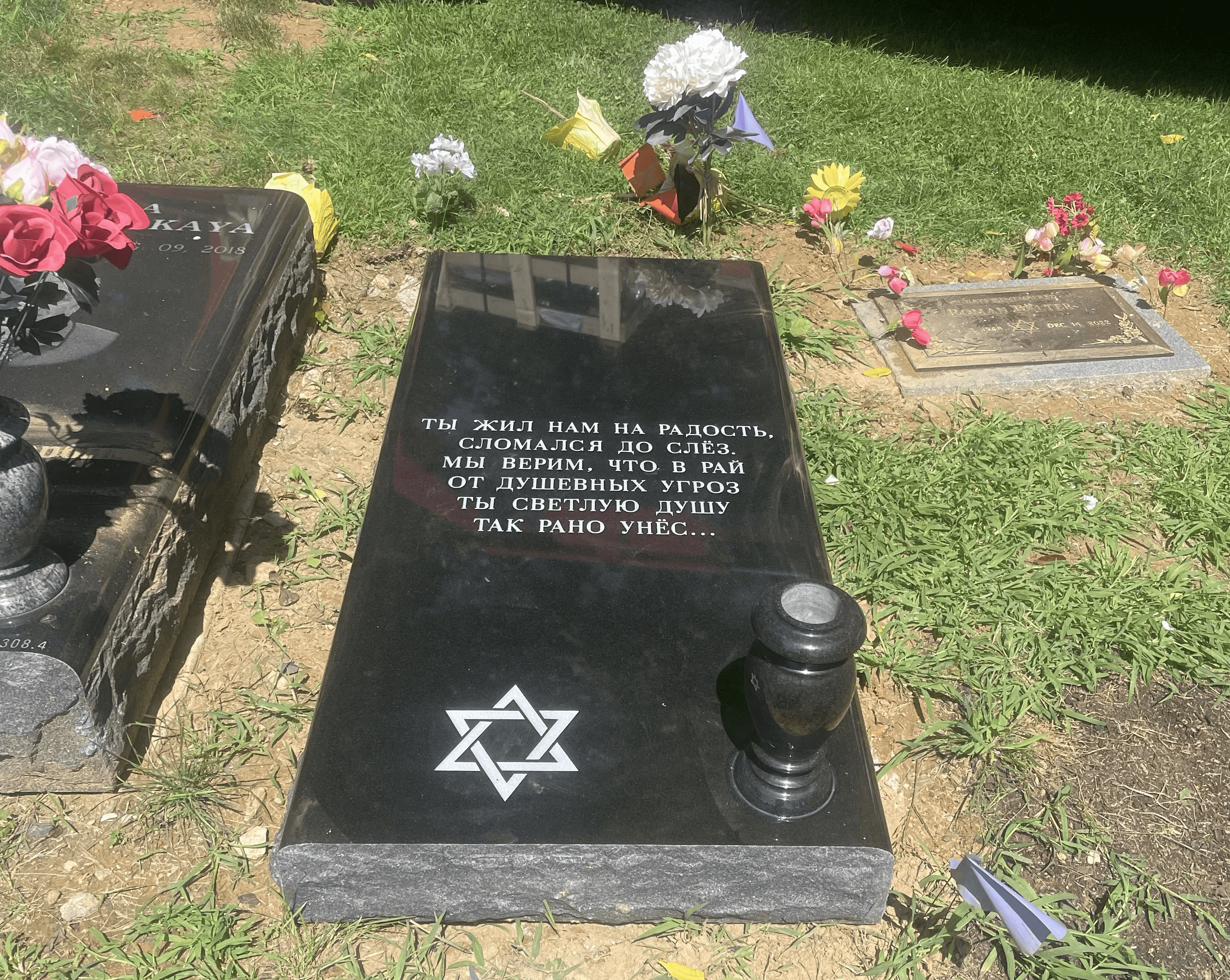
A ledger stone is a large horizontal memorial designed to cover most or all of an individual grave. While a standard flat marker usually occupies only a relatively small area at the head of the burial space, a ledger extends lengthwise over the grave itself. This larger surface creates a very different visual effect and gives families considerably more room to personalize the memorial.
You may also see these monuments described as grave ledgers, ledger headstones, full grave slabs, full grave covers or ledger grave markers. The terminology varies between monument companies and cemeteries, but these terms generally refer to the same basic concept: a substantial stone memorial positioned horizontally over the burial space.
A ledger can be used as the primary memorial, with the person's name, dates and inscription engraved directly into its surface. In other designs, the ledger is combined with an upright monument at the head of the grave. That combination creates a larger memorial in which the vertical stone becomes the main focal point while the ledger defines and decorates the burial space below it.
Why families choose full grave slabs
One of the main reasons families choose a ledger stone is simply the presence it creates at the gravesite. Instead of identifying the burial with a monument positioned only at the head of the grave, a full-cover memorial visually defines the entire space.
The larger granite surface also gives families much more flexibility with the design. A ledger can include a traditional name and date inscription while leaving enough room for a longer epitaph, scripture, floral carving, religious imagery or other personalized elements. Detailed portraits, landscapes and meaningful artwork can also be incorporated where the granite and cemetery requirements allow.
That does not mean every available section of the stone needs to be filled. In fact, some of the most effective ledger stone designs use the additional surface to create more breathing room around the inscription. A simple name, dates and religious symbol surrounded by carefully planned open granite can feel just as substantial as a highly detailed design.
For families looking for a more conventional memorial, a single upright headstone may provide enough personalization space without covering the grave. The choice between the two is largely about cemetery requirements, family preference and the overall appearance you want for the gravesite.
Ledger stones vs. flat markers and traditional headstones
A ledger stone is sometimes confused with a flat grave marker, but the difference is primarily scale. A flat marker generally marks only a small portion of the grave and may sit flush with or slightly above the surrounding lawn. A full grave slab extends across substantially more of the burial space and therefore requires more granite, a larger supporting foundation and a different installation process.
An upright headstone creates another very different appearance. Rather than extending across the burial space, an upright monument provides a vertical focal point that can be seen from a greater distance. Upright headstones remain one of the most traditional choices for New Jersey cemeteries and offer considerable space for names, dates, inscriptions and artwork.
Some families do not necessarily have to choose between the two. Where cemetery regulations permit it, a ledger can be combined with an upright headstone. When designed together, the upright monument and full grave slab can share the same granite, lettering, decorative elements and overall proportions so that the entire gravesite reads as one cohesive memorial.
Designing a custom ledger stone
The size of a ledger gives families considerable design freedom, but it also makes proportion particularly important. A full grave slab can look very simple and traditional or become a highly personalized memorial depending on how the surface is used.
A family might choose to place the person's name and dates toward the head of the ledger, followed by a meaningful epitaph or scripture. Another design might center the inscription within a carved border, with floral or religious imagery positioned around it. Dark polished granite can also provide a suitable surface for detailed portrait etching or other photographic artwork.
Religious designs are especially well suited to the larger surface of a ledger. Crosses, angels, praying hands, scripture and floral imagery can become prominent parts of the memorial without competing with the primary inscription. Jewish memorials may similarly incorporate Hebrew inscriptions, Stars of David and other traditional elements. Families considering this type of design can explore Abby Rose Inc.'s Jewish monuments for additional examples of how religious and personal elements can be incorporated into granite memorials.
The important thing is to treat the ledger as a complete composition rather than simply filling an unusually large piece of granite. Names and dates should remain immediately readable, and the artwork should support the memorial rather than overwhelm it.
Choosing granite for a full grave cover
Granite selection is particularly important with a ledger because of the amount of material involved. A full grave slab uses considerably more granite than a conventional marker, so both the appearance and cost of the stone become important considerations.
Traditional gray granite can create a classic cemetery appearance, while darker granite varieties can provide greater contrast for polished surfaces, detailed lettering and portrait etching. Families with existing memorials nearby may also want to choose a granite that complements other stones in the family plot.
Different finishes can be incorporated into the same memorial as well. Polished sections can create contrast around lettering or detailed artwork, while other finishes can give borders and surrounding surfaces a more traditional appearance. You can compare Abby Rose Inc.'s granite colors and memorial materials before deciding which stone works best for the design.
For an established family plot, it is worth looking at the existing monuments before making this decision. Matching an older granite exactly is not always possible, but the new ledger can often be designed to complement the color, proportions and lettering of the surrounding memorials.
How much does a ledger stone cost in New Jersey?
There is no standard price for a ledger stone because the cost depends heavily on the size, granite and complexity of the memorial. A full grave slab uses substantially more stone than a conventional flat marker, and its weight and dimensions can also create different foundation and installation requirements.
Granite color is one factor. The dimensions and thickness of the slab are others. From there, the amount of engraving, carving, portrait etching and custom artwork can affect the final price. A ledger paired with an upright headstone will naturally be a different project from a simple standalone grave slab.
Cemetery-related costs also need to be considered. Depending on the property, there may be charges associated with foundations, permits, installation or other cemetery services. These costs are not necessarily included when families see a ledger stone advertised online.
For that reason, comparing full grave slab headstones based on a photograph and starting price can be misleading. Two memorials that appear similar online may use different granite, have different dimensions or require completely different foundations once they are installed in a New Jersey cemetery.
The most accurate way to price a ledger is to begin with the cemetery and exact gravesite, confirm what is allowed, and then develop the memorial specifications around those requirements.
Cemetery rules for ledger stones in New Jersey
Cemetery regulations are one of the most important considerations when planning a ledger stone. Not every New Jersey cemetery permits full grave covers, and rules can sometimes vary between sections within the same property.
One section may allow upright monuments and ledgers while another requires only flat markers. Older cemetery sections may also operate under different monument requirements from newer lawn or memorial-park areas.
Where ledger stones are permitted, the cemetery may specify the maximum length and width, granite thickness, foundation requirements, distance from neighboring graves and how the monument must be installed. If the family wants to combine a ledger with an upright headstone, that combination may need separate approval as well.
This is why families should avoid ordering a full grave slab based simply on typical burial dimensions. The exact cemetery, section and plot need to be confirmed first.
Abby Rose Inc. regularly coordinates memorial work with cemeteries throughout New Jersey and Pennsylvania, allowing the applicable requirements to be reviewed before the memorial enters production. This avoids designing a stone that later needs to be resized or significantly changed because it does not meet the cemetery's specifications.
Foundations and installation matter more with a ledger
The physical size and weight of a ledger also make the foundation particularly important. A full slab needs proper support so that the granite remains stable and appropriately positioned over time.
The exact foundation requirements are determined by the cemetery and the memorial specifications. Soil conditions, slab dimensions and the cemetery's own installation standards can all affect how the memorial needs to be supported.
New Jersey weather is another practical consideration. Frozen ground, prolonged rain and saturated soil can occasionally affect cemetery foundation and installation schedules. Families planning a ledger for a particular anniversary, unveiling or other meaningful date should therefore allow enough time for design, cemetery approval, production and installation rather than treating the monument as something that can necessarily be placed immediately after it is completed.
Ledger stones for couples and family plots
Full grave slabs can also be incorporated into larger family arrangements. Spouses buried side by side, for example, may choose matching ledger stones with the same granite, lettering and decorative border. The individual inscriptions can remain distinct while the two graves feel visually connected.
Another option, depending on cemetery rules, is to coordinate the ledgers with a companion or double upright headstone. This can create a central monument for the couple with individual full grave covers extending from it.
The same principle can be applied to larger family plots. A family monument may serve as the central memorial while individual grave ledgers identify family members buried around it.
These arrangements require more planning than an individual headstone because future burials and inscriptions need to be considered. Before installing a large permanent slab, families should understand how the remaining plot will eventually be used so that today's memorial does not restrict tomorrow's options.
Can a ledger stone be added to an existing grave?
In some cases, families decide to create a full grave memorial years after the burial has taken place. An older flat marker may already be present, or the grave may have an upright headstone that the family wants to retain.
A ledger may still be possible, but the existing gravesite needs to be evaluated first. The cemetery must permit the addition, there needs to be sufficient space around neighboring memorials, and the existing monument has to be considered when determining the new slab's dimensions and design.
If an upright headstone will remain, the ledger should ideally complement it. Granite color, lettering style and proportions can be coordinated so the two pieces look intentional rather than like memorials installed at different times without reference to one another.
For older family plots, this is another area where local cemetery experience matters. What appears straightforward from photographs of the gravesite may involve section-specific requirements that need to be confirmed before granite is ordered.
Caring for a full grave slab
Because a ledger has a large horizontal surface, it naturally collects more leaves, pollen, dirt and organic material than an upright monument. Shade from nearby trees and cemetery irrigation can also affect how quickly buildup appears.
Granite itself is extremely durable, but it should still be cleaned appropriately. Harsh household chemicals, wire brushes and aggressive abrasive tools can damage the appearance of a memorial and should be avoided.
Families who want to maintain a ledger over time should use cleaning methods appropriate for cemetery granite and take particular care around etched portraits, lettering and polished surfaces.
The larger surface may require more occasional maintenance than an upright headstone, but proper granite and professional installation are designed to provide a permanent outdoor memorial capable of remaining at the gravesite for generations.
What the process looks like
Planning a ledger stone in New Jersey begins with confirming the cemetery and burial plot. Once the cemetery's requirements are understood, the family can decide whether a full grave slab is the right memorial and whether it will stand alone or be paired with an upright monument.
From there, the granite, dimensions and general design can be selected. Names, dates, inscriptions, religious elements, portraits and other artwork are then arranged into a complete layout for the family to review.
Only after the design and cemetery requirements have been addressed should the monument move into production. Once completed, the foundation and installation can be coordinated according to the cemetery's procedures.
This order is particularly important for ledger stones. With a conventional headstone, cemetery dimensions are already essential; with a large full-cover memorial, they become even more significant because small changes in width, length or foundation specifications can affect the entire piece.
Frequently asked questions
What is a ledger stone in a cemetery?
A ledger stone is a large horizontal granite memorial that covers most or all of a burial space. It may contain the primary inscription itself or be combined with an upright headstone.
Are ledger stones allowed in New Jersey cemeteries?
Some New Jersey cemeteries permit full grave slabs and others do not. Requirements may also vary between different sections of the same cemetery, so the exact gravesite should be verified before ordering.
Is a ledger stone the same as a flat grave marker?
No. A flat marker typically covers only a small area of the gravesite, while a ledger extends across most or all of the grave.
Can you combine a ledger stone with an upright headstone?
Yes, in cemeteries where this type of memorial arrangement is permitted. The two pieces can be designed together using the same granite, lettering and decorative elements.
How much does a ledger stone cost in NJ?
Pricing depends on the granite, dimensions, thickness, engraving, artwork, foundation, cemetery requirements and installation. Because full grave slabs use significantly more granite than standard markers, the complete memorial needs to be priced individually.
Can a ledger stone include a portrait or custom artwork?
Yes. Depending on the granite and cemetery rules, ledger stones can include portraits, religious imagery, floral designs, landscapes and other personalized artwork.
Can a ledger be added to an existing grave?
Potentially. The cemetery rules, existing monument, available space and foundation requirements need to be reviewed before determining whether a ledger can be added.
Planning a ledger stone in New Jersey
A ledger stone can create a substantial and highly personal memorial, but the best designs begin with practical information rather than granite or artwork. Knowing exactly what the cemetery permits gives the family a clear framework for deciding on the size, style and level of personalization that will work at the gravesite.
From a simple full grave slab with a traditional inscription to a more elaborate memorial combining a ledger with an upright headstone, portrait or religious artwork, each design can be adapted to the person being remembered and the cemetery where it will remain.
Abby Rose Inc. has more than 25 years of experience designing, engraving and installing custom headstones and monuments for families throughout New Jersey and Pennsylvania.
If you're considering a full grave slab, request a memorial consultation and our team can help you review the cemetery requirements and explore the available design options.
Similar Blogs
More Helpful Guides & Articles
Discover more articles about cemetery rules, bronze memorials, and headstone design to support your decision-making process.